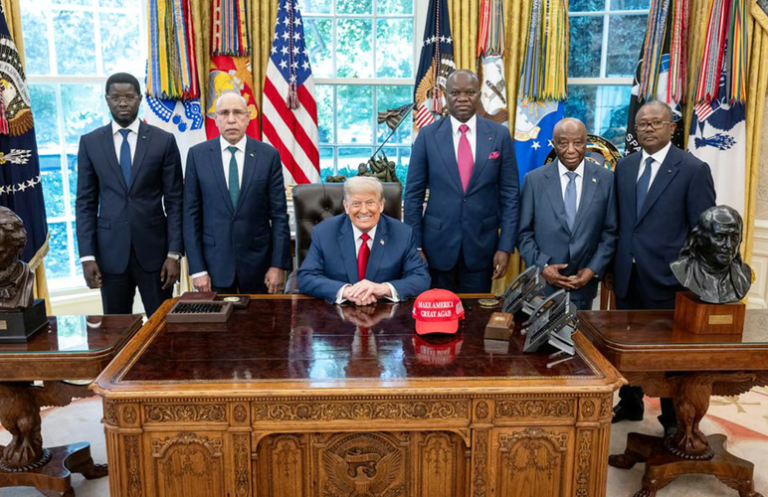
(AfriquesPlus) - Despite claims by Donald Trump’s administration that it has fundamentally overhauled American foreign policy on the continent, Washington’s strategy toward Africa remains defined by historic inconsistencies and vulnerable to manipulation by authoritarian leaders, according to an essay by Zachariah Mampilly published in Foreign Affairs for the July/August 2026 issue (released on June 23, 2026).
Reviewing a new book by UCLA scholar Sobukwe Odinga, Mampilly demonstrates that the current White House approach—marked by transactional dealmaking, punitive tariffs, cuts to foreign assistance, and alliances with autocrats—is a difference of degree rather than a fundamental break from past practices.
The Trump administration has framed its approach as a decisive rupture with previous decades of liberal interventionism. In a speech delivered on March 19, Nick Checker, the senior State Department official overseeing African affairs, stated: “The United States is resetting its relationship with Africa based on mutually beneficial partnerships rather than aid, dependency, and spreading divisive ideology. . . . It’s a radical but necessary corrective to the reckless pursuit of liberal hegemony over the last 30 years.”
External analysts initially accepted this interpretation, with a February 2025 Tony Blair Institute report noting that “under the new administration, U.S.-Africa relations will be explicitly pursued within the context of U.S. interests,” while The Guardian reported in December that “human rights and democracy promotion have been de-emphasized.”
However, Mampilly argues that Washington has long pursued informal security arrangements with authoritarians while maintaining disjointed, country-by-country policies. A prominent example remains Uganda: since 2007, the United States has provided billions of dollars in military assistance to President Yoweri Museveni to combat al-Shabab in Somalia. Yet two decades later, the militant group remains entrenched, while Museveni has faced minimal American criticism despite dismantling democratic checks and crushing domestic opposition.
Drawing on Odinga’s historical framework, Mampilly highlights that US Africa policy is shaped by three key forces: the American government, Black American advocates, and African heads of state. Within Washington, entrenched assumptions regarding the continent’s marginality resulted in a “dearth of long-term policy planning,” allowing competing factions to drive disjointed agendas.
Far from being passive recipients of great-power competition, Odinga emphasizes the “agency and guile of African leaders as they spurred Washington to back them in regional disputes, increase aid to their governments, and downplay criticisms of their domestic policies.” During the Cold War, Zaire’s Mobutu Sese Seko leveraged US anti-communist objectives to force favorable debt restructuring from international lenders.
This dynamic was further sustained by “Black moderate transnationalism,” a network of African American leaders and civil rights organizations that prioritized stability and sovereignty. Through this informal “shadow politics,” African leaders regularly secured backing in Washington, laying the groundwork for informal defense ties based on “sustained security cooperation, stable channels of communication, and the rapport and institutional memory of allied officials.”
While the influence of traditional Black moderates has waned since 2001, new demographics have emerged, including over 2.4 million African immigrants who lobby for specific home countries. Nevertheless, policy outcomes remain heavily driven by individual bargaining rather than coherent continental strategies.
This dynamic is evident in the 2025 bilateral strategic partnership between the United States and the Democratic Republic of the Congo. While presented by the Trump administration as an agreement securing strategic critical minerals for American firms, Mampilly points out that the primary winner was Congolese President Félix Tshisekedi. Facing domestic opposition and pursuing a third term, Tshisekedi leveraged ties to the administration to secure US military backing against eastern rebels and targeted sanctions against domestic rivals and foreign defense officials.
Mampilly warns that absent a shift toward democratic accountability and youth engagement, Washington’s transactional framework will continue to empower entrenched elites at the expense of ordinary citizens and US long-term interests.